





Apex Recognized for Outstanding Safety Performance
Map of emissions inventory reporting requirements for the state of Texas in 2022

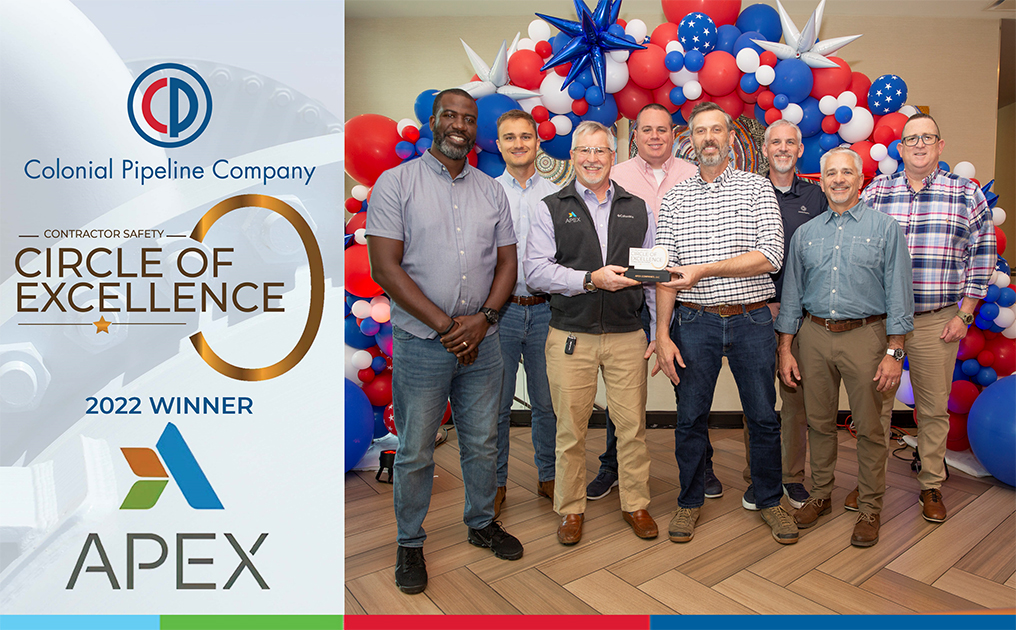
Accepting the award on behalf of Apex: Senior Program Manager John Strecker and Senior Project Manager Andrew Street

ROCKVILLE, MD—Apex is thrilled to share that we have been named a Circle of Excellence Award Honoree by Colonial Pipeline Company (CPC) for our outstanding safety record for the work performed during the 2022 calendar year. Apex is the only environmental consultant in the Southeast region who received this recognition in 2023. Our team was recognized at CPC’s District Contractor Symposium in Greenville, SC. This recognition was limited to CPC contractors who achieved the following safety results in 2022:

  • Zero OSHA Recordables (while working on Colonial sites/projects)
  • Zero Fatalities (across Apex)
  • Zero OSHA citations (Apex)
  • Zero Line/Equipment Strikes (Colonial)
  • Zero Product/Non-Product Spills (Colonial)
  • Contractor Performance Evaluation score of 87.5 percent or higher (Colonial)
  • TRIR less than or equal to Industry Average (Apex)
  • RAVS Written Program Score of 100 percent (Colonial)

“We strive to come to work each day with a safety-focus, and we empower our teams to put safety first. As one of our five core values, safety is part paramount to how we operate,” said Diane Anderson, Apex Southeast Regional Manager. “We could not be more pleased with the performance of our team, and their dedication to working and living safely. A special thanks to CPC for this award and acknowledgment of the Apex team.”

CPC operates based on the belief that “Zero is Possible” when it comes to workplace incidents. The organization was also recently recognized for its own outstanding safety performance, announcing its recognition by International Liquid Terminals Association (ILTA) on May 30, 2023. CPC received the ILTA’s 2023 Platinum Safety Award for its dedication to safety culture, including management commitment, employee participation, safety training, hazard identification and control, and safety program innovation.

About Apex Established in 1988, Apex is a multidisciplinary consulting and engineering firm with a robust portfolio of capabilities in water, environmental, infrastructure, health and safety, compliance and assurance, construction management, and transportation. The Company is highly regarded for its technical expertise, rapid response, operational integrity, and exceptional client satisfaction. Apex operates in all 50 states and maintains a highly capable and diverse team of scientists, geologists, engineers, consultants, technicians, and information management specialists.

About Colonial Pipeline: Colonial Pipeline Company, founded in 1962, connects refineries—primarily located in the Gulf Coast—with customers and markets throughout the Southern and Eastern United States. The company delivers refined petroleum products such as gasoline, diesel, jet fuel, home heating oil, and fuel for the US Military. Colonial is committed to safety and environmental stewardship across its operations. More information about Colonial is available at www.colpipe.com.

Apex Shortlisted for the Sustainability Consulting Awards 2023

Environment Analyst launched the Sustainability Consulting Awards to recognize ESG innovation, achievement and leadership, and celebrate consultancies who have made significant advances in both their own, and their clients’, sustainable transformation.

The Environment Analyst-led, independent judging panel includes industry experts and analysts, and is headed by Environment Analyst’s Managing Director Ross Griffiths and Cofounder and Director Liz Trew.

Apex is shortlisted for the 2023 ESG Innovation Award for ARTEMIS® ESG.

This year’s winners will be announced at the Sustainability Consulting Awards Ceremony on June 27, 2023 at the Radisson Blu Aqua Hotel in Chicago, Illinois.

Lesser Prairie-Chicken Listed Under Endangered Species Act

The lesser prairie-chicken,1 a bird species that is native to the Great Plains region of the United States, has been classified as threatened or endangered under the Endangered Species Act (ESA) by the US Fish and Wildlife Service.2 Lesser prairie-chickens require a significant range to live and to breed in the native short grass prairie, which is rapidly disappearing due to development and agricultural practices.

According to the Audubon Society, populations of the lesser prairie-chicken have declined 97 percent across their range since the 1960s. This steep decline also signals an overall degradation of habitat health, which is a troubling sign for other species that dwell in the grasslands, and a signal that our prairie lands are on a downturn. This is why the lesser prairie-chicken may be referred to as an umbrella species, as its protection ultimately helps other imperiled species that also live within its habitat.

The ESA provides legal protection to endangered and threatened species, which includes restrictions on activities that can harm the species or their habitat. Land developers must adhere to these regulations when planning and conducting development activities in areas inhabited by the lesser prairie-chicken.

The states covered under the ESA regulations for the lesser prairie-chicken include Texas, Oklahoma, Kansas, Colorado, and New Mexico. Developers in these states must obtain permits and follow strict guidelines before conducting any activities that may affect the habitat of the lesser prairie-chicken. The two subspecies of lesser prairie-chicken protected under the ESA are the Tympanuchus pallidicinctus and the Tympanuchus cupido attwateri.

Before beginning any development projects in areas inhabited by the lesser prairie-chicken, developers must conduct a habitat assessment and impact study to determine the potential effects of their activities on the species and their habitat. These studies must analyze the potential impact on the built environment and the species’ food supply, nesting areas, and breeding sites called leks. Lek identification surveys must be conducted during the period of mid-March into early May by certified biologists with documented experience in bird counting studies.

If the study determines that the new, or planned, development activities may negatively impact the species, the developer may be required to make changes to their plans or provide mitigation measures to minimize the harm to the lesser prairie-chicken and their habitat.

If you are looking to develop or expand your operations in a covered region, keep in mind that you will likely need to conduct impact studies to identify potential risks and potentially mitigate these risks. Apex can help you determine if you need to conduct impact studies, and if any other regulations may apply to your project. Contact us today for more information, or to connect with one of our subject matter experts!

1 National Audubon Society. 2023. Audubon Guide to North American Birds, Lesser Prairie-Chicken. https://www.audubon.org/field-guide/bird/lesser-prairie-chicken
2 United States Fish and Wildlife Service (FWS). November 2022. U.S. Fish and Wildlife Service Lists the Lesser Prairie-Chicken Under the Endangered Species Act. https://www.fws.gov/press-release/2022-11/lesser-prairie-chicken-listed-under-endangered-species-act

Woe to WOTUS? Wetlands Make a Splash in Recent Court Decision

On May 25, 2023, the Supreme Court1 delivered a decision limiting the Environmental Protection Agency’s (EPA) jurisdiction to enforce the Clean Water Act (CWA) as it relates to wetlands in the United States. The specific case, Sackett v. EPA, involved a couple who were fined for filling in a wetland without a permit on a residential property they purchased in 2003.

The Clean Water Act was amended in 1972 to safeguard the country’s waters, including wetlands, from pollution and degradation. These waters are commonly referred to as Waters of the United States or WOTUS. The Act’s stated objective was to “to restore and maintain the chemical, physical, and biological integrity of the nation’s waters.”2 Wetlands, traditionally included in the definition of WOTUS, play a vital role in supporting the ecosystem and are home to a diverse range of plant and animal species, including migratory birds, fish, and amphibians. Additionally, they purify water and reduce the impact of floods and storms.

Wetlands are those environmental features that include the following elements:

  • Wetlands contain saturated soils within their upper 12 inches, either permanently or seasonally.
  • Hydric soils; these are soils that formed under conditions of saturation, flooding, or ponding long enough during the growing season to develop anaerobic conditions in the upper part.
  • Plants that are adapted to saturated soils. These commonly include cattails, bulrushes, sedges, and many leafy herbaceous plants as well as trees tolerant of seasonally ponded or flooded conditions such as willows, red maples, and black gums.

In its most recent court decision, the Supreme Court adopted the plurality view in Rapanos v. United States, 547 U.S. 715, that wetlands are WOTUS only if they have “a continuous surface connection to bodies that are ‘waters of the United States’ in their own right, so that there is no clear demarcation between ‘waters’ and wetlands.” In other words, wetlands that are separated by an earthen berm or other feature from a WOTUS are no longer subject to protections under the CWA, even though their subsurface connections often ensure that they do have an impact on the “chemical, physical, and biological integrity” of nearby WOTUS lacking a “continuous surface connection.” Rapanos v. United States was a 2006 United States Supreme Court ruling on a case challenging federal jurisdiction to regulate isolated wetlands under the Clean Water Act.3

The Supreme Court’s May 2023 ruling on the CWA and WOTUS could significantly impact wetlands across the United States and have impacts on water quality standards, stormwater regulations, oil spill programs, and other activities that fall under the CWA.

Currently, property developers must still follow a detailed process to determine if their property contains a wetland. This entails conducting a wetland delineation study which includes a site visit by a qualified professional to determine the presence and extent of wetland features. The results must be submitted to the appropriate regulatory agency, typically the EPA or the US Army Corps of Engineers. If the study determines that the property includes a wetland, property developers must obtain a permit from the Army Corps of Engineers before conducting any activities that may impact the wetland. If you suspect that a site that you are developing contains a wetland, Apex can help. To learn more about our natural resources solutions, including wetland delineation, reach out to us today and we will connect you with a subject matter expert who can help with your specific needs.

1 Supreme Court of the United States. May 2023. 21-454 Sackett ET UX. v. Environmental Protection Agency ET Al. https://www.supremecourt.gov/opinions/22pdf/21-454_4g15.pdf
2 EPA (US Environmental Protection Agency). October 2016. EPA History: Water—The Challenge of the Environment: A Primer on EPA’s Statutory Authority. https://www.epa.gov/archive/epa/aboutepa/epa-history-water-challenge-environment-primer-epas-statutory-authority.html
3 EPA (US Environmental Protection Agency). May 2023. Rapanos v. United States & Carabell v. United States. https://www.epa.gov/wotus/rapanos-v-united-states-carabell-v-united-states

Zweig 2023 Hot Firm Award Winner

Apex Companies, LLC is honored to receive the Zweig Group’s Hot Firm Award for the fourth consecutive year. The Hot Firm List recognizes the 100 fastest-growing architecture, engineering, and construction (AEC) firms in the United States and Canada. Hats off to both our back-office team and operational personnel across the country whose hard work and dedication to our clients shines with this most recent accomplishment!

Apex also ranks among ENR’s Top 30 All-Environmental Firms (#13 in 2022).

See the complete list of the 2023 Hot Firm winners.

Capabilities Inquiry