




Due Diligence Support

Environmental Project

Due Diligence Support

Two Confidential Major Electric and Gas Utility Companies Midwestern United States

Solution Overview

Client:

Two confidential major utility companies

Business Challenge:

  • Tight timelines for due diligence at multiple sites with different historical uses

Solution:

  • Utilization of experienced staff for expertise and quick turnaround

Results:

  • Timely and thorough due diligence reports, facilitating a timely and informed business transaction

Challenge

Beginning in October of 2020 through April of 2021, Apex Companies was contracted by two major electric and gas utility companies to provide environmental due diligence support for multiple assets across the Midwest. The primary scopes of work consisted of Phase I environmental site assessments (ESAs) including identification of hazardous building materials.

Solution

Annually, Apex completes hundreds of Phase I and II ESAs for clients nationwide. Our clients typically request due diligence support during development/redevelopment projects, mergers, acquisitions, or divestitures when trying to identify potential risk exposure. For these specific projects our clients were planning to redevelop and acquire new property.

During a Phase I process we routinely perform visual checks for non-American Society for Testing and Materials (ASTM) scope items which for these projects included suspected lead-based paint (LBP) and asbestos containing materials (ACMs), apparent wetlands, and the observation of mold, radon, and flood zones.

Results

The results of the Phase I ESAs ranged from no Recognized Environmental Conditions (RECs) identified to sites with multiple RECs for which the client also authorized Apex to conduct a Phase II ESA. Examples of RECs identified included residual pesticides and arsenic from one site’s use as a previous orchard, potential lead contamination in soil due to peeling paint from the building which was built in the 1800s, and another included an adjacent landfill.

The proposed turnaround time to complete draft reports for the previously mentioned Phase I scopes of work was three weeks. By using experienced staff that were proactive in coordinating with the owner and completing the work assignments, Apex was able to deliver draft reports to the client within two weeks. Apex was successful in completing all Phase I ESAs within the contracted budget. Both clients recently awarded new projects to Apex and continue to seek support for both due diligence and other environmental needs.
How Can We Help You Succeed?

Due Diligence, Assessment, Monitoring, and Underground Storage Tank Removal

Environmental Project

Due Diligence, Assessment, Monitoring, and Underground Storage Tank Removal

Car Wash Operator Multiple Locations Throughout Florida and Eastern US

Solution Overview

Client:

Car Wash Operator

Business Challenge:

  • Successfully redevelop contaminated sites into car wash facilities

Solution:

  • Quantify potential costs and liabilities associated with purchase and construction on contaminated properties
  • Work with client and seller’s representatives to enable redevelopment by addressing issues such as timing of any required remediation

Results:

  • Development of highly popular car wash facilities in strategic locations

Challenge

Apex has provided Phase I and II environmental site assessment (ESA) services for our client since 2017. Our client initially purchased seven car wash locations in Miami-Dade County and is continuing the purchase and construction of car wash locations throughout Florida and the eastern United States. Many of the properties were former gas stations or automotive repair locations, which are well situated for car washes.

Solution

Apex has conducted Phase I and II ESAs in support of the expansion effort. As part of the due diligence effort, Apex has conducted project feasibility studies to determine potential costs for cleanup and consulting with seller’s consultants to determine potential risks associated with construction on contaminated sites.

Apex has also provided site assessment, remediation, and groundwater monitoring services. Apex conducted underground storage tank (UST) removal and assessment at a former automotive repair facility when three previously-unknown USTs were discovered during construction of a new car wash facility. Apex has also conducted groundwater monitoring at one facility when the former property failed to do so.

Scope of Services Provided:

  • Environmental due diligence: Phase I and II ESAs
  • Site assessment and groundwater monitoring
  • UST removal and assessment
  • Feasibility studies to determine potential costs for cleanup and consulting with seller’s consultants to determine potential risks associated with construction on contaminated sites

Results

Apex has developed an effective collaboration with this client since 2017. In addition to completion of standard Phase I and II ESAs, we also work with our client to conduct desk top reviews and develop order of magnitude remediation costs for known contaminated properties. When the need arises, Apex has jumped in and addressed immediate environmental needs, such as expeditiously removing previously unknown underground storage tanks discovered during construction of a new car wash or conducting agency‑required groundwater monitoring.

How Can We Help You Succeed?

Remediation of Arsenic‑Contaminated Soil and Groundwater

Environmental Project

Remediation of Arsenic‑Contaminated Soil and Groundwater

Confidential Golf Course Owner-Operator Southeastern United States

Solution Overview

Client:

Confidential golf course owner-operator

Business Challenge:

  • Elevated levels of arsenic found in soil and groundwater
  • High voltage underground electrical utilities in the area

Solution:

  • Careful coordination with Florida Power & Light (FPL) for source removal/soil excavation
  • Implementation of engineering and institutional controls to address contaminated soil and shrink extent of arsenic in groundwater within the property boundaries

Results:

  • Successful remediation during unrestricted closure of adjacent properties and conditional closure of the maintenance area
  • Services conducted to date within client’s original budget and schedule

Challenge

Restoration of properties for new or altered use comes with many challenges. As new and virgin land in desirable locations becomes more scarce, savvy property developers will often look to decrepit, defunct, and contaminated sites as options for their projects. As such, skilled consultants are an essential partner to ensure that the condition of the site is restored to ensure adequate safe-guarding of both human health and sensitive environmental receptors. Arsenic is a common contaminant used historically on golf courses and in landscaping to prevent the growth of nuisance weeds and is also contained in some fertilizers. As such, many golf courses have been found to be contaminated due to the historical application of arsenic, especially in tee box areas and greens. Storage and mixing of arsenical herbicides has also resulted in the contamination of maintenance areas. A golf course owner operator in South Florida approached Apex Companies to help assess and remediate a former country club maintenance area in Lauderhill, Broward County, Florida. In this case, the owner-operator wanted to remediate the site, continue its use as a golf course, and ensure that conditions at the site were restored for any altered future use.

Solution

Drawing on our staff’s golf course remediation expertise, Apex conducted groundwater monitoring, site assessment, and developed a conceptual site model remedial design to determine arsenic contamination within and outside of property boundaries—the areas of the site that were most likely to have elevated levels of arsenic in soil and groundwater. Site assessment indicated the presence of arsenic in soil in concentrations greater than allowable limits; arsenic in soil extended onto the western adjacent property belonging to FPL’s Woodlands Substation.

Site assessment also indicated arsenic groundwater contamination to a depth of 65 feet that extended onto the eastern and western adjacent properties. Given the abundance of high voltage underground electrical utilities in the source removal/soil excavation area, Apex staff regularly interacted with FPL, especially for the soil remediation/source removal.

Based upon assessment data, Apex implemented source removal activities to remediate soil on the western adjacent property and used engineering and institutional controls to address soil on the golf course maintenance area property. Similarly, we designed a remedial approach to shrink the extent of arsenic in groundwater to within the maintenance area property boundaries. Groundwater remedial design consisted of the injection of an amendment designed to drive the aquifer to extreme reducing conditions to precipitate arsenic from groundwater with the introduction of iron and sulfate designed to form arseno-pyrite compounds. Apex performed two injection events and successfully remediated groundwater on the western adjacent FPL substation property but not on the eastern adjacent property where the size of the arsenic plume was much larger.

Results

Apex successfully implemented a combination of active remediation and engineering and institutional controls, as well as a remedial approach designed to provide unrestricted closure of adjacent properties and conditional closure of the maintenance area. Remedial activities were completed within budget and regulatory time frames.

Efforts to obtain closure of the eastern adjacent property using non-recorded institutional controls are ongoing. Apex has supported this effort with stormwater mounding and nearby irrigation well analysis.

How Can We Help You Succeed?

Oxbow Restoration is a Win for the Environment and Communities

Environmental Project

Oxbow Restoration is a Win for the Environment and Communities

The Nature Conservancy Iowa

Solution Overview

Oxbow restoration

Client:

The Nature Conservancy

Business Challenge:

  • Restore vital avian and riparian habitat while ensuring the safe, effective management of existing watershed quality

Solution:

  • Develop a plan to address both structural and environmental aspects of oxbow restoration
  • Execute excavation while maintaining riverbank integrity following the installation of wildflowers and grasses designed to restore native species habitat

Results:

  • Reduced nitrate levels in the river
  • Renewed wildlife habitats
  • Improved water quality
  • Ensured flood management for the arboretum

Challenge

Rivers naturally want to curve and meander through our landscape. Over time, the force of the water erodes through bends and river banks causing portions of the old channel to become abandoned as the river creates a new path. These abandoned channels in the river are called oxbows.

In the 20th century, farmers straightened rivers to increase land availability. Floodwaters, instead of soaking into the water table, sliced straight down the river channels, which in turn increased erosion, nutrient runoff, and the likelihood of downstream floods. At the same time, farmers began spreading manufactured nitrate fertilizer on their fields. That nitrate washes out into river channels, contaminating water sources.

Over time, many oxbows dried up and disappeared, and with them, the habitat for hundreds of species of birds and fish, and in Iowa, this included the endangered Topeka shiner.

Additionally, since oxbows provide storage for 1M gallons of floodwater per acre of oxbow wetland, their disappearance and degradation impacts local flooding and can lead to adverse impacts to nearby infrastructure.

Since 2017, 14 oxbows have been recreated in communities across Iowa under a partnership between The Nature Conservancy and the Polk Soil and Water Conservation District (SWCD). Apex Companies was hired to provide safe, effective water resource management in an additional local watershed, which The Nature Conservancy seeks to protect and preserve.

Solution

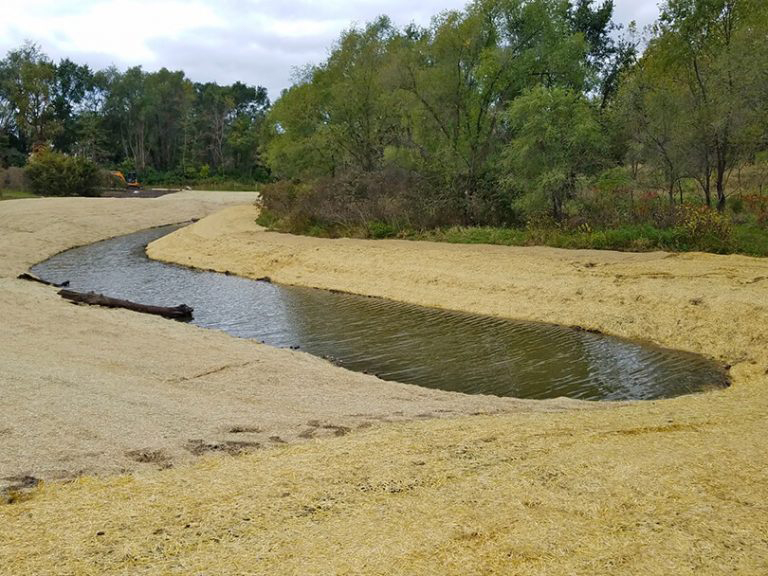
To restore an oxbow, restoration crews excavate accumulated sediment down to the original level of the stream channel. The restored oxbow is left to fill with water and the banks are seeded with natural vegetation. Once reconstructed and naturally refilled, oxbows:

  • Offer an efficient way to rebuild water storage
  • Create a habitat for both birds and fish
  • Help control flooding
  • Provide reliable water sources for livestock
  • Remove and sequester 45-90% of nitrates from water runoff
  • Create enhanced recreational fishing opportunities

After the Brenton Arboretum, a 141-acre botanical garden in Iowa was identified as a site where oxbow restoration could lead to significant benefits, our Apex team excavated 3K+ cubic yards of soil from a 400-foot section of abandoned river channel. After the oxbow was created, the team seeded the banks to a mix of native wildflowers and grasses before installing straw matting to hold soil and seed in place during the establishment phase.

Results

Our work restored the oxbow which reduced nitrate levels in the river, established wildlife habitats for a variety of species, filtered water for improved quality, and helped ensure flood management for the arboretum.

How Can We Help You Succeed?

Colorado’s Most-Valuable Brownfields Redevelopment Project

Environmental Project

Colorado’s Most-Valuable Brownfields Redevelopment Project

Commercial and Residential Developer Denver, CO

Solution Overview

Client:

Commercial and residential developer

Business Challenge:

  • 57-acre former rubber factory
  • Complex contaminant mix
  • Intense stakeholder scrutiny

Solution:

  • Regulatory negotiations
  • Characterization and drilling
  • In-situ remedy implementation
  • Sampling and waste identification
  • Phase II investigation
  • Voluntary Cleanup Program (VCP) application

Results:

  • Identification, removal, and disposal of ~19K cu. yd. of contaminated soil and asbestos
  • Cost-effective remedial approach
  • Accelerated remedial timeframe
  • Received regulatory No Action Determination (NAD) allowing initiation of redevelopment for mixed commercial and residential use

Photo Credit: Plazak at English Wikipedia.

Challenge

Arguably the most-valuable Brownfields project in Colorado, the Former Gates Rubber Factory covers 57 acres in the heart of the City of Denver. Our client depended on Apex Companies to navigate this high-profile redevelopment project through intense stakeholder scrutiny due to its size, proximity to the South Platte River, and long industrial history. The site has a complex contaminant mix of chlorinated solvents, petroleum NAPL, and emerging chemicals of concern from several sources.

Solution

Apex partnered closely with the property owner during regulatory negotiations with the Colorado Department of Public Health and Environment (CDPHE) and provided technical oversight throughout the project. Apex also directly performed site work across the full spectrum of environmental management, from characterization and drilling, to excavations, to in-situ remedy implementation, to performance sampling and extensive waste identification, and management during site redevelopment.

The site had been dormant for a decade, despite its valuable location, due to the complex bedrock lithology, chlorinated solvent contamination, and presence of emerging chemicals of concern. Apex directed a fresh Phase II investigation using innovative subsurface imaging technology and a discerning review of older characterization data. The updated conceptual site model revealed dominant pathways for contaminant movement and risk exposure that completely changed the regulatory view and previously-scoped remediation needs. The result was a far more cost-effective remedial approach and accelerated remedial timeframe. Apex then negotiated a new risk-based cleanup approach with state and municipal regulators, authored the Voluntary Cleanup Program (VCP) application, and oversaw implementation of the remedy.

Results

Apex supervised the large-scale enhanced reductive dichlorination (ERD) in-situ remedy for chlorinated solvent impacts to soil and groundwater across the site. The remedy included several rounds of ERD injections to target two primary source areas, and satellite injections for disconnected portions of the plume. Apex also performed two complex excavations (totaling approximately 4,500 cubic yards) among remaining building foundations to remove unsaturated soils with residual NAPL and impacts from chlorinated solvents.

Apex worked with the property owner during numerous negotiations with regulators, authored decision documents, and prepared a series of CDPHE-approved No Action Determination (NAD) requests, development lot by development lot, as portions of the property were remediated. The last of the redevelopment parcels received regulatory NAD in November 2017, allowing the initiation of redevelopment for mixed commercial and residential use.

On behalf of the property owner, Apex managed general compliance with the site’s Materials Management Plan (MMP) by all contractors during site redevelopment, which included the excavation of 14 acres of former buried buildings and their concrete foundations, totaling approximately 130,000 cubic yards. Apex also conducted environmental testing, segregation, and management of hazardous and non‑hazardous materials that were exposed at this long‑time industrial facility.

Apex’s team of environmental engineers, certified asbestos building inspectors (CABIs), and abatement subcontractors worked with the developers to identify, properly remove, and dispose of approximately 19,000 cubic yards of regulated asbestos-contaminated soil (RACS) and asbestos in demolished structures.

Today, the site is one of the most marketable redevelopment districts in Denver. Labeled Midtown/Broadway Station due to its close proximity to the Broadway Light Rail Station, the transit friendly site will support a mix of residential, commercial, and recreational uses. We are excited to see what the future will bring for this high potential site, and are proud to have been a partner in its redevelopment and return to beneficial use!

How Can We Help You Succeed?

Life Cycle: Siting to Decommissioning

Environmental Project

Life Cycle: Siting to Decommissioning

Fortune 500 Corporation Midwest, Williston, Permian, and Rocky Mountain Regions

Solution Overview

Client:

Fortune 500 energy provider

Business Challenge:

  • 38K miles of pipeline and integrated facilities
  • Siting of new assets
  • Operation and maintenance (O&M) of existing assets

Solution:

  • Assessments
  • Permitting
  • Environmental desktop reviews
  • Cultural resource evaluations and surveys
  • Development of operational procedures

Results:

  • Compliance with all applicable local, state, and federal regulations

Challenge

This Fortune 500 energy provider was founded over a century ago. With over 38K miles of pipeline and integrated facilities, the siting of new assets and the operation and maintenance of existing assets is a constant endeavor.

Apex Companies provides this client with environmental services to assist with avoidance, minimization, permitting, and mitigation of environmental impacts across all stages of development.

Solution

Our services include environmental desktop reviews, Waters of the US assessments, US Army Corps of Engineers permitting, cultural resource evaluations and surveys, threatened and endangered species habitat assessments, species protocol surveys, flood plain permitting, permitting of ground bed installations, stormwater management, migratory bird surveys, and the development of operational procedures for environmental protection. Our work helps our client achieve compliance with all applicable local, state, and federal regulations including the Clean Water Act, the Migratory Bird Treaty Act, the Bald and Golden Eagle Protection Act, the Endangered Species Act, the National Historic Protection Act, and the National Flood Insurance Act.

Results

Across all assets, our client aspires to be 100% compliant with applicable laws, regulations, and internal procedures. As we continue to work directly with their operational divisions to help them protect our natural resources, Apex is consistently praised by their management and associates for our quick response time and our understanding of their assets and objectives.

How Can We Help You Succeed?

Two Decades of Remediation Services and Project Management Support

Environmental Project

Two Decades of Remediation Services and Project Management Support

Defense Logistics Agency (DLA) Southern California

Solution Overview

Client:

DLA

Business Challenge:

DLA operates a network of facilities, handling both dangerous goods, hazardous materials, and the conveyance of these materials to their destinations.

Solution:

Apex has provided an array of environmental engineering services including:

  • Preparation of health and safety (H&S) plans
  • Quality assurance project plans (QAPPs)
  • Waste management plans
  • Coordinated lab activities
  • Site assessment
  • Remedial action design
  • Remediation system operation and maintenance (O&M)
  • Groundwater monitoring and sampling services
  • Compliance and permitting

Results:

At the completion of this project, nearly 500K cy of contaminated soil and associated contaminated groundwater will be remediated.

Challenge

The DLA manages the global supply chain for the Army, Navy, Marine Corps, Air Force, Space Force, Coast Guard, eleven combatant commands, and various other federal agencies for the entire nation. This includes overall management of a global supply chain that supplies 86 percent of the military’s spare parts and close to 100 percent of the fuel and troop support consumables. As such, DLA operates a network of facilities across the nation, handling both dangerous goods and hazardous materials, and the conveyance of these materials to their destinations.

Solution

Since 2002, Apex Companies, LLC [Apex]/The Source Group, Inc. [SGI] (Apex-SGI), has provided an array of environmental engineering services at two DLA‑operated military fuel storage and distribution facilities located in Southern California.

Over the past five years alone, our work at these sites has included preparation of H&S plans, QAPPs, waste management plans, coordinated lab activities, site assessment, remedial action design, remediation system O&M, groundwater and monitoring and sampling services, and compliance and permitting under numerous ongoing contracts.

We have performed O&M of over ten separate remediation systems which utilize groundwater extraction and treatment, biologic treatment processes, air sparging, light nonaqueous-phase liquid (LNAPL) recovery, thermal treatment, and/or vapor extraction technologies. Tasks completed included site investigations, groundwater monitoring and sampling, public participation support and engagement, and reporting (over 200 reports are generated each year); and conducting work in accordance with DLA Facilities Management, compliance, and permitting requirements.

Our services also include providing thermal remediation support to remediate petroleum contaminated soil and groundwater at nine areas of concern (AOC) located at the site:

  • Working in concert with thermal remediation technology specialists, Apex-SGI’s engineers, geologists, and environmental specialists have completed the remediation of soil and groundwater at two former 2.1M-gallon capacity bulk, field‑constructed underground storage tanks (BFCUSTs) using steam injection and electrical resistance heating (ERH) methods. Thermal remediation systems are currently in operation at three additional BFCUST sites and preparations are underway for installation of similar systems at four more BFCUSTs
  • As part of this turnkey project, Apex-SGI completed investigations to delineate the extents of the target remedial zones, prepared agency-approved remedial action designs and plans, installed the multi‑component treatment systems, and conducted remediation system O&M, and groundwater monitoring and sampling.
  • Thermal remediation required remediation personnel to be on-site 24 hours a day, including weekends. Apex-SGI addressed this requirement in the project management plan and then coordinated security access and a communication structure to ensure access to the site for multiple crews.
  • After approximately 12 months of active thermal remediation was completed, Apex-SGI conducted rebound testing, soil matrix confirmation sampling, and soil gas sampling at the first two thermal remediation sites. The results of this confirmation testing and analysis was used as the basis for preparing detailed Remedial Action Completion Reports (RACRs) for review by DLA and submittal to state regulators.

Results

We have earned repeated accolades from successive DLA project managers. In its recent CPAR (federal government rating system), DLA ranked Apex-SGI’s management at Defense Fuel Support Point (DFSP) San Pedro as “Exceptional” in the areas of quality, schedule cost control, management, and regulatory compliance. After removing over 260K pounds of hydrocarbon mass at the two former fuel storage tanks, the completion of confirmation soil sampling to confirm that soil cleanup goals had been achieved, and post‑treatment soil gas surveying demonstrated that no residual hydrocarbons were present in shallow soil gas, the State Board agreed that the thermal remediation phase of remediation was complete.

Apex-SGI is currently responsible for the remediation of soil and groundwater at over 20 AOCs at the facility, with a goal to complete all active remediation by the end of 2025. At the completion of this project, nearly 500K cy of contaminated soil and associated contaminated groundwater will be remediated.

How Can We Help You Succeed?

International Environmental Due Diligence Portfolio

Environmental Project

International Environmental Due Diligence Portfolio

Multiple Domestic and International Locations

Solution Overview

Client:

Fortune 500 International Manufacturing Client

Business Challenge:

The client required environmental due diligence for the divestiture of two business units from an international manufacturing corporation.

Solution:

Apex performed Phase I ESAs and Desktop Reviews, and authored a report detailing the findings and assessing the overall risk profile.

Results:

Apex’s assistance enabled the client to complete a successful sale of both business units to another Fortune 500 international manufacturing entity.

Challenge

The client engaged Apex Companies to perform environmental due diligence for the divestiture of two business units for an international manufacturing client. A total of 31 active locations (26 domestic; five international) were assessed by Apex in a six week timeframe. Apex also conducted a review of legacy locations associated with the business units. The portfolio included numerous heavy manufacturing locations in the United States with over 50 years of history. Additionally, the portfolio included a property located in Connecticut that was potentially subject to the Connecticut Transfer Act.

Solution

Apex used a tiered approach to due diligence performing Phase I ESAs on manufacturing and/or owned real estate and Desktop Reviews on warehouse and/or leased facilities. We authored a final summary report detailing the salient environmental findings and assessing the overall risk profile. These deliverables were made available to potential purchasers to evaluate during their own diligence.

Results

Apex completed the project on time and provided meaningful support to the client after delivery of our final report. This assistance enabled the client to complete a successful sale of both business units to another Fortune 500 international manufacturing entity.

How Can We Help You Succeed?

2020 Hurricane Season

Environmental Project

2020 Hurricane Season

Texas, Louisiana, Mississippi, Alabama, and Florida

Solution Overview

Client:

Multiple clients

Business Challenge:

The record-breaking 2020 hurricane season produced 30 named storms and resulted in over $51B in damages.

Solution:

Apex’s industrial hygiene specialists performed asbestos sampling; moisture mapping; damage assessments; indoor air quality assessments; remediation/restoration protocols; remediation/restoration oversight; asbestos abatement oversight; and microbial, asbestos, and bacterial clearance testing.

Results:

Thanks to our rapid response, our clients were often able to return to operations within a week of the initial storm damage.

Challenge

The record-breaking 2020 hurricane season produced 30 named storms, including six major hurricanes, and resulted in over $51B in damages and approximately 430 deaths.

Solution

Apex Companies' industrial hygiene specialists quickly mobilized—often within 24 hours—across Texas, Louisiana, Mississippi, Alabama, and Florida.

We performed asbestos sampling; moisture mapping; damage assessments; indoor air quality assessments; remediation/restoration protocols; remediation/restoration oversight; asbestos abatement oversight; and microbial, asbestos, and bacterial clearance testing—in accordance with all federal, state, and local regulations

Results

We serviced ~128 sites ranging from a single retail suite to an entire hospital facility, condominium buildings, and casinos.

Thanks to our rapid response, our clients were able to restore their properties quickly, safely, and efficiently and often return to operations within a week of the initial storm damage.

How Can We Help You Succeed?

Multi-Media Sampling for Fire Training Facilities

Environmental Project

Multi-Media Sampling for Fire Training Facilities

Confidential Client Western US

Solution Overview

Client:

Confidential client

Business Challenge:

Apex is investigating per-and polyfluoroalkyl substances (PFAS) in soil, groundwater, surface water, stormwater, and sediment at a fire training facility.

Solution:

Apex has conducted several rounds of assessment to determine whether PFAS was present in sampled media and then to define the magnitude and extent of PFAS impacts at the site and downgradient.

Results:

PFAS have been detected in multiple media at the site, but exposures are below the current relevant standards. Apex continuously monitors the regulatory environment in all 50 states which allows our client to proactively consider the range of pending and promulgated US standards to assess PFAS impacts for this ongoing project.

Challenge

On behalf of our client and in collaboration with state and local regulatory agencies, Apex Companies is investigating PFAS in soil, groundwater, surface water, stormwater, and sediment at a former fire training facility.

Fire training facilities across the country historically have used aqueous film forming foam (AFFF) which contains PFAS. Perfluorooctane sulfonate (PFOS) and perfluorooctanoic acid (PFOA) have been the primary PFAS historically used as agents in AFFF and produced in the largest quantities within the US. The US Environmental Protection Agency (EPA) has determined that the toxicity, mobility, and bioaccumulation characteristics of PFOS and PFOA pose potentially adverse effects for the environment and human health1.

The fire-fighting community is in a difficult situation, caught between the use of highly effective AFFF for extinguishing petroleum fueled fires and the impacts to human health and the environment from releases of PFAS. For example, airports are in a unique situation with PFAS in that they are regulated under Federal Aviation Administration (FAA) and National Fire Protection Association (NFPA) regulations and guidance, which identify the type, testing, use, and training that has been required for lawful use of AFFF. The requirements governing the type of AFFF, frequency of live‑fire training, and equipment testing protocols at airports has varied over the past four decades since AFFF was original developed. Since 2002, airports have been required to store, maintain, and use military‑specified AFFF in accordance with current FAA codes and regulations. Prior to 2002, the FAA required that airports use AFFF that met the Underwriters Laboratory (UL) Standard for Safety for Foam Equipment and Liquid Concentrates (UL 162) but recommended airports provide greater aircraft rescue and firefighting capability. Consequently, AFFF Military Spec was used at over 75 percent of civil aviation facilities.

Solution

Apex has conducted several rounds of assessment to determine whether PFAS was present in sampled media and then to define the magnitude and extent of PFAS impacts at the site and downgradient. Samples were collected in accordance with the Apex standard operating procedures (SOP), as well as project-specific sampling and analysis procedures for avoidance of PFAS cross-contamination. Finding elevated concentrations of PFAS in soil and groundwater led to additional investigation surface water and sediments and expanded groundwater monitoring. Continued monitoring to delineate the extent of PFAS may lead to a remediation plan, if necessary. Groundwater in the site vicinity is currently used for irrigation, landscaping, and golf courses.

Results

Since there are no current regulatory standards for PFAS components in most states, Apex continuously monitors the regulatory environment in all 50 states. This allows our client to proactively consider the range of pending and promulgated US standards to assess PFAS impacts for this ongoing project.

  1. EPA (US Environmental Protection Agency). 2017. Technical Fact Sheet – Perfluorooctane Sulfonate (PFOS) and Perfluorooctanoic Acid (PFOA). https://19january2021snapshot.epa.gov/sites/static/files/2017-12/documents/ffrrofactsheet_contaminants_pfos_pfoa_11-20-17_508_0.pdf.

How Can We Help You Succeed?

Capabilities Inquiry