Safety First, Safety Always, and Safety After a Shutdown or Hiatus

As businesses like yours prepare to restart, ramp up, and return to normal production capacities, you can face many challenges including retraining your workforce and ensuring that COVID-19 implemented changes are understood by all levels of your organization.

But what about the normal, everyday worker responsibilities that may have become a faint memory due to an extended absence or changes to physical demands due to a prolonged production slowdown?

To reduce your chances of a spike in injuries and incidents, here are a few things to help prepare your workforce and your business:

Worker Self-Assessment Checklist Considerations

A worker self-assessment checklist is not only a great idea to assess for COVID-19 symptoms, but it will also help your workers acknowledge if they are truly prepared to return to their position. A few worker-related questions should include:

  • Worker scanning his surroundingsAre you physically capable of performing all aspects of your job?
  • Have there been changes in your physical health that could impact your ability to perform essential responsibilities associated with your position?
  • Have there been any changes in your work environment that alter how you do your job or your personal safety? A good tip is to size up your work area with a Take 5 to Scan 10 (take 5 seconds to scan 10’ around you).
  • Have you inspected your personal protective equipment (PPE) prior to using it to ensure it’s in good condition and proper working condition? For example, if you use a cartridge respirator, do the cartridges need to be replaced?
  • Has your Work Statement or any of your job duties changed? If so, are there any new hazards or exposures you need to consider?
  • Do you feel comfortable performing all aspects of your job?

Management Checklist Considerations

As employees return to the workplace, your management team should review their operations, develop initiatives, and take action to ensure that the workplace is as safe as possible. A few management-related questions should include:

  • Has specific equipment sat idle for a period of time and if so, should it be inspected by an expert or third party prior to its use? Is lubrication, adjustment, or other maintenance needed prior to start up?
  • Are there key positions that involve more risk than others that require additional worker safety training or retraining?
  • Are there employees with limited experience that may have a more challenging time identifying issues such as Lockout/Tagout (LOTO) or machine guarding? If so, should I limit their activities for a period of time until they refamiliarize themselves with the hazards?
  • Is the appropriate signage in place to remind workers of new policies and procedures related to COVID-19?
  • Do the engineering controls and other changes implemented due to COVID-19 pose reduce worker efficiencies, create additional steps, etc. that could inadvertently result workarounds or unsafe working conditions?

During the coming months, we’re likely to see a rise in soft-tissue injuries, strains, sprains, and other work-related injuries. Taking a moment to assess your workforce and challenge your individual workers to raise any concerns can greatly reduce that risk.

Download our simple checklist, and if you need help with retraining, job hazard analyses (JHAs), or workplace risk assessments including ergonomics, please contact us today!

Industry Alert: NFPA 652 Combustible Dust Hazard Analysis

Each year, combustible dust explosions result in fatalities, injuries, millions of dollars in capital costs, hefty litigation fees, and stringent regulatory action. To safeguard companies and their employees, the National Fire Protection Association (NFPA) issued Standard 652 to address combustible dust. All facilities that produce combustible dust must complete a Dust Hazard Analysis (DHA) by September 7, 2020 to comply with the NFPA Standard 652.

What exactly is combustible dust?

A combustible dust is any fine material that can catch fire and explode when mixed with air. Surprisingly, many organic materials such as flour, sugar, wood dust, grains, starch, potatoes, and even rice are combustible under the right conditions. Additionally, metals, plastics, chemicals, rubber, pharmaceuticals, and textile dusts are also commonly combustible. These products or materials may be stored in silos or containers, may gather in buildings at the eves, rafters, on the roofs, and various other places.

How does a dust explosion occur?

Fuel, oxygen, ignition source, ideal dispersion, confinement of the dust cloud


What types of facilities must comply?

  • Food production and agricultural processing facilities
  • Chemical, pharmaceutical and general manufacturing facilities
  • Lumber processing or woodworking facilities
  • Metal processing and fabrication facilities
  • Recycling facilities
  • Power plants fired by coal
  • Mining and process industries

What is the risk?

According to the Chemical Safety Board (CSB), from 2003‑2017, nine combustible incidents killed 55 people and injured hundreds more.

Beyond the potentially fatal consequences, combustible dust hazards can result in OSHA enforcement actions and monetary penalties.

How stringent is this compliance requirement?

After the National Emphasis Program on combustible dust was rolled out, OSHA began its inspection and enforcement program. In just two years, they inspected over 1,000 facilities and issued over 4,900 violations. Of these citations, 75% were levied from federal inspectors and 34% from state inspectors.

With the enforcement of NFPA 652, those inspections will increase. Moreover, once employers are on notice of combustible issues because of an incident or OSHA citation at any of their facilities, OSHA may treat future violations as willful, and civil liability increases.1

What do you need to do?

Put safety first. While NFPA itself doesn’t have regulatory authority, OSHA currently follows NFPA standards to ensure that facilities stay safe while handling potentially explosive/combustible materials. If your facility falls within one of these at-risk industry sectors, you may need to conduct a DHA, if you haven’t already. You will also need to complete a DHA if you have experienced or adapted any process change since your last DHA. As guidance evolves, variables such as storage and confinement conditions change, and combustible dust accumulates over time, DHAs should be reviewed and updated every five years.

This is where Apex can help. We will review your facility, processes, documents, and your existing engineering and administrative controls. This will identify where a hazard may exist and any associated risks, as well as ensure that the appropriate safeguards are in place based on NFPA 652 requirements.

What OSHA standards apply to NFPA 652?

  • General Duty Clause, Section 5(a)(1) of the Occupational Safety and Health Act (Employers must keep workplaces free from recognized hazards likely to cause death or serious physical harm).
  • §1910.22 General requirements
  • §1910.38 Emergency action plans
  • §1910.39 Fire prevention plans
  • §1910.94 Ventilation
  • §1910.146 Permit-required confined spaces
  • §1910.157 Portable fire extinguishers
  • §1910.165 Employee alarm systems
  • §1910.176 Handling materials—general
  • §1910.178 Powered industrial trucks
  • §1910.261 Pulp, paper, and paperboard mills
  • §1910.263 Bakery equipment
  • §1910.265 Sawmills
  • §1910.269 Electric power generation, transmission and distribution
  • §1910.272 Grain handling facilities
  • §1910.307 Hazardous (classified) locations
  • §1910.1200 Hazard communication
  • §1910.119 Process safety management

1 Source; Howard Mavity, Partner, Fisher Phillips law firm: Workplace Health & Safety Law Blog, July 13, 2018.

PFAS Regulations & Your State

What is PFAS?

PFAS, also known as “forever chemicals” refers to a class of thousands of synthetic man-made substances that have been used in industry and consumer products worldwide since the 1940s. Due to their unique and extremely strong chemical bond, these compounds are resistant to heat, grease, water and oil. They have been used in non-stick cookware, food packaging, dental floss, pizza boxes, household cleaners, water-repellent clothing, cosmetics and firefighting foams.

Why are people talking about PFAS?

High levels of PFAS have been linked to numerous negative health effects over long exposure periods. Recently, the CDC published a study that found that PFAS could pose risks to human health at levels that are up to 10 times lower than what the EPA currently considers ‘safe.’

How are PFAS regulated?

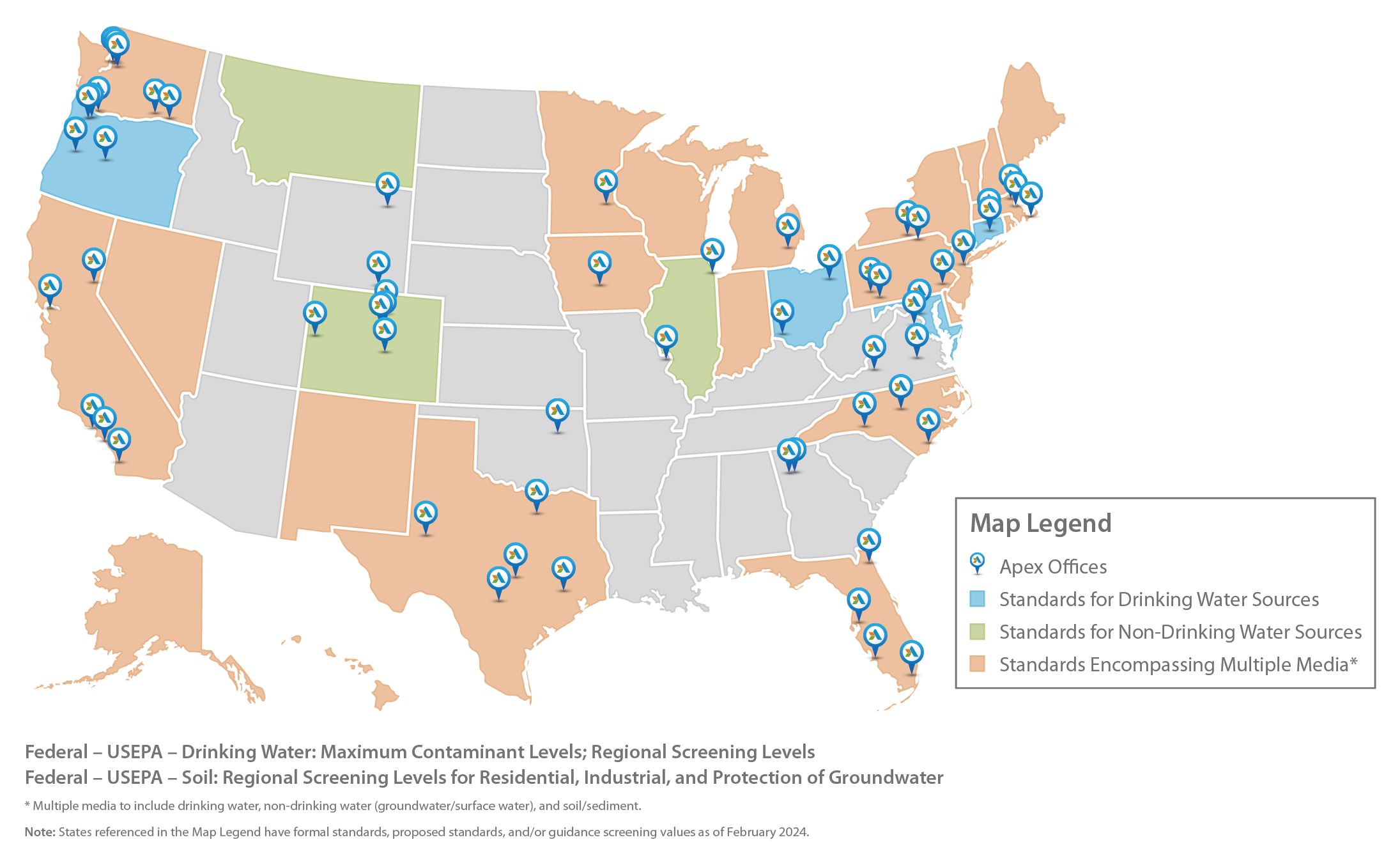
The EPA has established a health advisory level, and to date, 23 states have already implemented their own requirements. The existing EPA guidance criteria are referenced below:

Drinking Water:

Maximum Contaminant Levels
Regional Screening Levels

Soil:

Regional Screening Levels for Residential, Industrial, and Protection of Groundwater

What are states doing?

North Carolina—a state with significant chemical manufacturing activity—is currently leading the charge with the introduction of seven bills to regulate PFAS compounds. But nearly half of the states have introduced requirements with many more following in their footsteps.


Apex PFAS map


How is your state handling PFAS?

Unsure if your state is regulating PFAS or how to achieve compliance? Contact us to discuss the requirements where you are located.

Industry Alert: New PA State Requirement—Proactive Facility Cleaning to Reduce COVID-19 Risk

To protect the public from the spread of COVID-19 risk, the PA Department of Health has issued an order regarding specific safety measures for building facilities.

Who does this impact?

Operations designated as “essential” in the state of Pennsylvania which meet the following criteria:

  • Warehouse
  • Manufacturing
  • Commercial offices
  • Airports
  • Grocery stores
  • Universities & colleges
  • Government
  • Hotels
  • Residential buildings with at least 50 units

If my company fits the criteria, what do I need to do?

  1. Maintain pre-existing cleaning protocols for all areas of your building;
  2. Supplement pre-existing maintenance protocols by routinely cleaning and disinfecting high-touch areas (e.g. accessible to customers, tenants, or other individuals), in accordance with CDC guidelines;
  3. Ensure that you have enough employees to perform the above protocols effectively to protect the safety of all occupants and employees;
  4. Ensure that you have enough security employees to control access, maintain order, and enforce social distancing of at least 6 feet.

To view the official order, please visit the Pennsylvania Department of Health.

Are you prepared?

Apex can help. Our team can identify the proper training requirements, provide required training, develop guidance for your employees and/or contractors; and provide oversight to ensure conformance with these new state requirements.

How can we help?

Our services include:

  • Cleaning and Disinfection Protocol and Plan Development
  • Third Party Cleaning and Disinfection Protocol Conformance Oversight
  • Turnkey Cleaning and Disinfection including Biohazardous Waste Removal
  • Workforce Training and Education
  • Environmental, Health & Safety (EHS) Short- and Long‑Term Staff Augmentation

Why Apex?

We’ve assembled a best-in-class team of professionals. Our ready-to-deploy team with toxicology and public health backgrounds includes PhDs, Chemical and Biological Threat Mitigation Specialists, Certified Industrial Hygienists (CIHs), Certified Safety Professionals (CSPs), and experts with Masters of Science in Public Health (MSPH) degrees who are dedicated to addressing your coronavirus needs.

Our approaches are rooted in the latest technical guidance and our teams are knowledgeable in the most up-to‑date CDC‑recommended standard, contact, and airborne precautions for coronavirus management.

As one of the largest industrial hygiene firms in the country, we have 30+ years of environmental excellence, 1000+ professionals, and 50+ offices nationwide ready to manage your coronavirus risk.

Dust Masks and COVID-19

As the Coronavirus continues to propagate through the country and into our communities, many people are leaning on self-proclaimed “experts” to determine the best course of action to protect themselves. The product which is most sought after, other than toilet paper and hand sanitizer, is the “dust mask” or “facemask.” This term is used interchangeably for a paper-like mask that covers your face. It is believed that a dust mask protects you from dust and other airborne contaminants. This term makes its way into the vernacular of seasoned health and safety professionals, as well as highly educated medical professionals. The problem is when it is used so interchangeably, it spreads misinformation that may confuse the public and cause a dangerous and false sense of security. People hear terms like N95, N100, P99, surgical mask and on. What do those terms mean? How do you know if it is actually protecting you?

First, it is important to note that according to current guidance from the Centers for Disease Control and Prevention (CDC), facemasks are only to be used if you are sick and you will be around other people or if you are caring for a sick person who is not able to wear a facemask. In this case, “facemask” means a surgical mask. A surgical mask is a covering for your nose and mouth which will stop or slow aerosolized saliva created when you breathe, sneeze, or cough. It helps reduce airborne viruses, thus the likelihood of spreading the virus. It will do very little to prevent contracting the virus. It is only indicated for protection against large droplets, splashes, or sprays of hazardous fluids. A surgical mask does not seal tightly against your face, so air will very likely flow around the mask and into the upper respiratory tract (URT). A virus can be between 0.004 to 0.1 microns in size. It can and will flow through and around products that are not designed to filter them out of the air you breathe. It is important to note that a surgical mask is not an approved respirator according to the National Institute for Occupational Safety and Health (NIOSH), a division of the CDC. Wait…what?!?

What is a respirator and when should you use one?

According to NIOSH, a respirator is: “a personal protective device that is worn on the face or head and covers at least the nose and mouth. A respirator is used to reduce the wearer’s risk of inhaling hazardous airborne particles (including infectious agents), gases or vapors. Respirators, including those intended for use in healthcare settings, are certified by the CDC/NIOSH.”

NIOSH approved dust mask

Respirators are worn to protect people from a known airborne hazard. Respirators undergo rigorous testing, approval, and certification process administered by NIOSH to ensure they meet the requirements of the Occupational Safety and Health Act of 1970 (OSHA) Respiratory Protection Standard. NIOSH publishes a Certified Equipment List (CEL) of all approved respirators. If a “dust mask” does not contain a NIOSH approval number on the box/label and the mask itself, it is not approved to be used as a respirator and cannot be guaranteed to filter contaminants from the air you breathe.

Side by side comparison of NIOSH approved and not approved dust masks

A “dust mask” which is a NIOSH approved respirator is also called a filtering facepiece respirator (FFR). All FFRs are given efficiency ratings such as N95 or P100. Let’s break these down into their individual components. The leading letters are defined as follows:

  • N = Not resistant to oil
  • R = Somewhat resistant to oil
  • P = Strongly resistant to oil

The numbers in the designation are defined as follows:

  • 95 = Filters at least 95% of airborne particles
  • 99 = Filters at least 99% of airborne particles
  • 100 = Filters at least 99.97% of airborne particles

“A respirator is a personal protective device that is worn on the face or head and covers at least the nose and mouth. A respirator is used to reduce the wearer’s risk of inhaling hazardous airborne particles (including infectious agents), gases or vapors. Respirators, including those intended for use in healthcare settings, are certified by the CDC/NIOSH.”

So, you’ve found a NIOSH approved N95 FFR. Congratulations, you’re one of the lucky few. Just because you are wearing a respirator, it doesn’t mean you are automatically protected. There are several factors that can contribute to rendering your new respirator virtually useless. Here are questions you need to, not only ask yourself, but know how to answer them:

  • Does it fit?
  • Is it damaged?
  • Is it contaminated?
  • How should I dispose of it?
  • Can my heart and lungs handle wearing it?

Does It Fit?

When wearing a respirator in a workplace situation where it is required, a fit test must be performed. In this case, it isn’t (or maybe, check with your supervisor if it is) required by your employer, so how do you know if it fits? First of all, you cannot have any facial hair that interferes with the seal. NIOSH has released an info-graphic entitled Facial Hairstyles and Filtering Facepiece Respirators which provides a pictorial reference of what types of facial hair are allowed while wearing an N95 FFR.

You also need to perform a user seal check. With an FFR, a user seal check can be very difficult and will vary by make and model. For exact instructions, check the package your N95 came in. Generally, a positive user seal check is the only way to conduct this test. You should cover as much of the respirator as you can with your hands without collapsing the respirator or pushing it against your face. Exhale gently into the facepiece. A slight positive pressure should build up in the respirator and is evidence it is fitting you properly. If you feel air rushing in around your nose or chin, it doesn’t fit properly and requires adjustment. I can’t stress enough that this is a critical step to avoid a false sense of security. If it does not fit, you may contaminate the inside of your N95, defeating the purpose of wearing it in the first place.

Is It Damaged?

Every time you put a respirator on, you should check it for damage. Check for the following:

  • Rips/Holes in the filter
  • Worn elastic on the head and neck bands
  • Head/Neck bands that have become detached from the facepiece
  • Missing/Torn exhalation valve (if applicable)

Any damaged respirator should be disposed of immediately and not be used. I often recommend destroying it further so it cannot be used instead of just throwing it on top of the trash where someone can easily remove it and use it. You would be surprised what a desperate person may do during a pandemic.

Is It Contaminated?

A contaminated respirator is a dangerous respirator. If you wear your respirator around a person known to have been exposed to the SARS-CoV-2 virus and is showing signs of having contracted COVID-19, your respirator is now likely contaminated. Worse yet, if it doesn’t fit (see above), the inside may be contaminated. When you are protecting yourself from a contaminant that is invisible to the naked eye, like a virus, it is best to dispose of your mask as soon as you leave a known contaminated area and wash your hands for at least 20 seconds and then wash your face. This article does not address other protective clothing and other types of contamination. See the CDC website for more information on how to protect yourself from contracting COVID-19.

How Should I Dispose of It?

When you’re done with your N95 respirator, proper disposal is important. Never leave a used respirator laying around or directly on top of the trash bin. If possible, destroy the respirator prior to disposal and always remember to wash your hands and avoid touching your face before doing so.

Can My Heart and Lungs Handle Wearing It?

In an industrial environment, a FFR does not always require medical clearance prior to wearing one. However, in the public, people with far more advanced underlying conditions may consider wearing a FFR to protect themselves. A FFR will put strain on your body. It requires additional breathing capacity to inhale the same amount of air needed to oxygenate your blood through a filter that removes at least 95% of particulates in that air. Additionally, wearing a FFR when you are sick with a pulmonary disease, further straining your respiratory system could cause excessive stress on your heart and lungs. Finally, add any potential physical exertion and your heart and lungs may suddenly be working several orders of magnitude harder than normal. Check with your doctor if you have any conditions that may be exacerbated by wearing a FFR before you use one.

As you can see, there are a lot of considerations for using an N95 respirator. Since the CDC is recommending the general public NOT to use them, I would prefer my friends, family, and colleagues follow that recommendation. Most of all, please do not use any “homemade” masks. No man-made fabric will provide the level of protection you need and there is no way they will meet the rigorous NIOSH requirements to be approved as a respirator or surgical mask.

Conclusion

Please consider all of the potential implications of hoarding and using masks for which you are not properly trained to use. Healthcare professionals are trained to ensure these masks are not only put to good use caring for your family and friends, but are used properly to prevent the spreading of disease or further damaging their own health. Definitely don’t use ANY homemade mask that someone you know made out of craft fabric, yarn, or any other man-made fabric which is not designed to keep saliva particles out or in. You may get some protection from using the wrong face mask, but odds are high that you will be doing far more harm than good. Finally, if you witness this misinformation on social media, in public or within your own circle of family and friends; please help set the record straight so we can all help stop the spread of this deadly disease.

Industry Insights: California SB 205 FAQs

The Link Between Business Permits and National Pollutant Discharge Elimination Permits (NPDES)

Effective January 1, 2020, under California’s Senate Bill 205 (SB 205), every business seeking a new or renewed business license in California must prove one of three things:

  • It’s registered under the NPDES Industrial General Permit (IGP) for Storm Water Discharges Associated with Industrial Activities, 2014-0057-DWQ;
  • It holds an NPDES stormwater permit; or
  • It’s not required to have a stormwater permit.

This new requirement could delay or even prohibit the issuance or renewal of a business license (Link 1). Knowing the facts, however, can keep you covered.

What changed?

Does this affect me?

It will not affect all businesses. Only those with primary Standard Industrial Classification (SIC) codes that are identified in or are applicable to the IGP. There are over 800 SIC codes that fall into this category such as manufacturing, transportation, warehousing, mining, etc., so it’s essential to verify your SIC code for applicability.

SB 205 seeks to identify non-filers and unpermitted facilities by requiring cities and counties to verify IGP coverage before issuing a new or renewed business license. Facilities with an already existing IGP coverage, Notice of Non-Applicability (NONA), or a No Exposure Certification (NEC), do not require any action.

What if I don’t have existing IGP coverage?

This means your business will have to:

  • Evaluate each operating facility to determine your primary Standard Industrial Classification (SIC) code, which is based on the primary purpose of each business. (Link 3)
  • Determine if the SIC code is for a regulated industrial activity by referring to Attachment A of the IGP, or by consulting the list of regulated industrial SIC codes found on the State Water Board website at (Link 4).
  • If possible, obtain a NEC if your facility can demonstrate that all your industrial activity is occurring under cover and not exposed to rainfall or runoff. Or, obtain IGP coverage for each facility with a regulated SIC code(s).
Before SB 205 Today
Businesses were required to comply with the IGP issued by State Water Resources Control Board (SWRCB) or obtain a general permit for stormwater discharges under the federal Clean Water Act. That remains the same. However, with SB 205, California cities and counties which issue business licenses must confirm that anyone applying for a new business license or seeking to renew an existing one has either registered for coverage under the State’s stormwater regulations or is not required to register with the SWRCB. (Link 2)
This broad requirement often left businesses unsure if their stormwater was regulated or not. SB 205 seeks to identify non‑filers and unpermitted facilities for increased enforcement of stormwater regulations.

How can I prepare for compliance?

With SB 205, cities and counties may give businesses 90 days to comply. If you need IGP permit coverage due to SB 205, you should quickly retain a professional stormwater consultant to provide compliance assistance.You can qualify for up to 100% credit for additional activities.

If you need help, Apex is available to assist.

NOTE: A New Discharger (as defined in Attachment C of the IGP) applying for coverage under the IGP that will be discharging to an impaired water body with a 303(d) listed impairment are ineligible for coverage unless the Discharger submits data and/or information, prepared by a Qualified Industrial SWPPP Practitioner (QISP), demonstrating that the facility will not cause or contribute to the impairment. If the facility needs to enroll in the IGP, they will be considered a New Discharger and will need to seek the assistance of a QISP to demonstrate eligibility for coverage through preparing the data and/or information required in Section VII.B of the IGP. (Link 5)


Helpful Links:

  1. SB 205 Text: http://leginfo.legislature.ca.gov/faces/billNavClient.xhtml?bill_id=201920200SB205
  2. SWRCB Information regarding SB205: https://www.waterboards.ca.gov/water_issues/programs/stormwater/sb_205_business_license_requirements.html
  3. OSHA SIC Code Tool: https://www.osha.gov/pls/imis/sicsearch.html
  4. SWRCB SIC Codes covered under the IGP: https://www.waterboards.ca.gov/water_issues/programs/stormwater/sicnum.shtml
  5. The IGP: https://www.waterboards.ca.gov/water_issues/programs/stormwater/docs/tmdl_igp/amend/amend_igp_order.pdf

Holiday Season Safety Tips

For many, the holiday season is a celebratory time of year, but it could also be very hectic with everything you need to. Between hanging lights around your home to making a large family feast to driving across the state to visit family, all could potentially lead to some dangerous oversight. Here are some quick tips to prepare you for a safe and happy holiday season.

Safe Decorating

Decorating your home, yard or workplace is a great and fun way to get into the holiday spirit. However, doing so without safety in mind could result in an un-festive and stressful holiday season. Review these quick safety decorating tips before getting started:

  • Carefully inspect all decorations when taking them out of storage. Check glass ornaments for cracks and check electrical decorations for frayed wires or loose connections.
  • If you have a Christmas tree, ensure that your tree is placed away from any heat sources such as space heaters and fireplaces, and if it is a live tree be sure it has plenty of water to prevent drying out and becoming more of a fire hazard.
  • When putting up lights outside your home make sure your ladder is in good condition and is placed on a secure and level surface before climbing. Use a tool belt or backpack to prevent climbing the ladder with your hands full.
  • Use clips versus nails to hang your lights to prevent damage to the wiring.
  • Use proper electrical protection such as ground fault circuit interrupters (GFCIs), and weather-proof connections to keep water away. GFCIs will shut down the circuit if there is ground fault caused by a short.
  • Prevent trips and falls by placing cords in low traffic areas and taping them down.
  • Turn off all lights, decorations, and candles before leaving the house or going to bed.

Food Safety

Enjoying a delicious holiday feast with family and friends is one of the greatest highlights of the holiday season. But preparing large family meals can be challenging and requires an understanding of food safety. Here are some food handling tips that can help:

  • Before prepping, cooking or serving food, make sure to wash your hands thoroughly.
  • Avoid cross-contaminating fresh food with raw meats and poultry by using different cutting boards and serving utensils.
  • Never leave the stove unattended, even for a few minutes—and turn off burners if you leave the kitchen.
  • Use a thermometer to check that all foods have been cooked to proper temperatures.
  • Make sure to properly store away leftovers; don’t leave cooked food out for longer than 2 hours. Leftovers are safe for 3-4 days if refrigerated properly.
  • Check with your guests for any food allergies and dietary restrictions.

Driving Safely

Whether you are driving out of state to visit family or driving downtown to meet friends to celebrate the holidays, be prepared for your trip and take extra precaution during the holiday season.

  • Check your car tires and top off fluids to make sure your vehicle is ready for colder weather.
  • Plan your route and review your local weather updates before getting on the road.
  • Be prepared for emergencies and keep a safety bag in your car. Consider including items such as: flashlight, water, first aid kit, blankets, gloves or hats, phone charger, and snacks.
  • Stay alert and drive defensively during the holidays and increase the spacing between you and the car in front of you. There may be an increased number of drowsy drivers, tipsy drivers, and/or drivers from out of town who don’t know your local roads well.
  • Don’t Drink and Drive! With so many options for ride shares, public transportation, and taxis these days there is no reason to risk harming you or others on the road.

Enjoy a safe and healthy holiday season!

Identifying Stray Gas Leaks: Biogenic or Thermogenic?

Identifying the source(s) and composition of alleged stray gas can be challenging. It may be due to the site operations, a natural condition, or a combination of both. It may be non-threatening. Or it could pose a significant risk.

Biogenic methane is quite common. And it could be the source of your alleged stray gas. But when human health and safety is at risk, you must have the defensible data to know for sure. On the positive side, that knowledge will help you decide when you need to assess or halt operations and when you can proceed safely.

To develop defensible conclusions regarding methane source(s), successful protocols involve:

  • Using a variety of methods, including Summa cannisters and laboratory-proprietary apparatus, to collect samples.
  • Applying specialized and tiered analytical methane differentiation techniques to test the gas samples.

Carefully interpreting the data using multiple lines of evidence and the principles that include the following:

  • Thermogenic methane is produced by thermal cracking of heavier hydrocarbons and some of the more volatile heavier hydrocarbons like butane, pentane and hexane are often present. However, the absence of these heavier hydrocarbons is not proof that the methane is biogenic.
  • Biogenic methane (typically almost 100% pure) is produced by low temperature biological processes and butane, pentane and hexane are usually absent from its pure form.
  • Hydrocarbon species testing are not 100% conclusive in most cases. To increase certainty, we always also look at the stable isotope ratios for carbon and hydrogen in the methane.
  • Individual isotope testing results are cross-plotted and typically fall into one of three methane genesis regions. However, some samples may plot in inconclusive areas between regions. This can occur due to mixing of methane from different sources or other factors and requires expert interpretation.

Differentiating biogenic from thermogenic methane helps you pinpoint the origin/potential source(s) and plan your path forward.

With the right protocol, you can determine your risk(s), define the origin and identify potential sources of stray gas, and delineate the extent of any migration/stray gas plumes. You can then implement measures to ensure public health and safety; evaluate natural background gas concentrations in the area; conduct periodic monitoring to define trends and confirm a remedy; and proactively understand and address any contributing factors that may affect migration pathways; and seal/remediate any root causes, if necessary.

At Apex, we can help. Contact us to learn more.

Industry Alert: Measure W—Reduce Runoff and Reduce Taxes

A ballot Measure W for a special parcel tax within the Los Angeles County Flood Control District was passed by voters on November 6, 2018. You can review a summary of Measure W at safecleanwaterla.org.

This Measure authorizes the Los Angeles County Flood Control District to levy a special tax annually on parcels within the District at a rate of $0.025 (2.5 cents) per square foot of land impermeable to water which includes buildings roofs, driveways, hardscape, and concrete areas but doesn’t include vegetated and other natural permeable areas where water penetrates through the ground. The tax revenue—which property owners have to pay—would enable projects, infrastructure, and programs to capture, treat, and recycle rainwater. The tax, however, is a tough burden to bear. For example, an average sized, big-box retail store can expect a tax bill of $6K-$20K in early October 2019. And that tax is annual, recurring every year thereafter.

Fortunately, there are ways to reduce or eliminate the Measure W Parcel Tax. Here’s how:

Tax Reductions

As a property owner, you lower your tax by reducing the square footage of impervious area on your property. The District has provided two potential offramps: the Appeals Process or the Credit Program. If the District miscalculated your effective impervious area, you can file an appeal. For example, if your impervious parking areas drain stormwater to bioswales or dry wells and the District failed to take them into consideration when calculating parcel tax, you can submit a correction to the County’s record to appeal and reduce your tax.

Under the Credit Program, you can reduce your Parcel Tax for new development projects by constructing rock-lined swales, infiltration structures, or rain barrels to capture and recycle stormwater. For existing parcels, retrofits are also an option. Installing an underground stormwater detention and infiltration-type cistern also qualifies. Removing concrete parking areas and replacing them with something porous, like gravel or paving blocks that water can pass through, will make a significant impact as those portions of your square footage would no longer be subject to the tax.

Information on both the credit program and the appeals process can be found at safecleanwaterla.org.

Timeline: Expect Parcel Tax bills by early October 2019 with a due date of November 1, 2019.

Tax Appeals

  • If you believe your tax is wrong, an appeals process is available.
  • A web tool has been developed to help expedite appeals process.
  • You can appeal if you have a discrepancy of more than 10% error of the Impermeable Area and a $50 difference in the tax amount.
  • Approved appeals will typically be credited to subsequent tax bill.

Access the Parcel Tax Calculator Tool the District uses to assess your tax.

Credit Program

  • You can qualify for a tax reduction with stormwater improvements (SUSMP, IGP, LID, and equivalent).
  • You can qualify for up to 100% credit for additional activities.
  • Your stormwater improvement initiatives must have a water quality benefit, additional credit for water supply, community investment, and additional activities.

Ready to reduce your taxes? Apex can help.

Quick Summary of America’s Water Infrastructure Act

As you may know, President Trump just signed a key piece of legislation, America’s Water Infrastructure Act (S.2800 or AWIA).

We’ve summarized the four main areas, or titles, below:

  • Title I: The US Army Corps of Engineers can now proceed with proposed port, waterway, flood protection, and other water infrastructure improvements.
  • Title II: More funding allocations to our nation’s drinking water systems will provide safer, improved water quality.
  • Title III: Eliminating regulatory permitting hurdles, this paves the way for hydropower as an clean, sustainable, renewable energy source.
  • Title IV: This will drive much-needed stormwater and wastewater infrastructure improvements powered by long-term, low-cost supplemental loans to help finance those advancements

If you have any questions about planned or proposed projects related to AWIA, please contact us.

Capabilities Inquiry